The instruments you depend on in the OR don’t clean and sterilize themselves. Here’s what it takes, and why it matters to every clinician on the surgical team.
For most members of the perioperative team, the instrument tray appears at the surgical tech’s back table like a fact of life, wrapped, labeled, and ready. What happened between the end of thelast case and this moment is largely invisible. That invisibility, for the sterile processingtechnician, is actually the goal. When SPD does its job well, nobody notices. When something goes wrong, a bioburden failure, a missing instrument, a wet pack, everyone notices immediately.
Understanding what sterile processing technicians actually do, and the complexity of what theymanage, makes you a better partner to them and a more informed advocate for patient safety on your unit.
The Shift Starts Before the OR Does
In most facilities, sterile processing runs around the clock, but the day shift often begins wellbefore the first incision. Technicians arrive to find case carts from overnight cases waiting at thedecontamination window, along with priority requests from the OR schedule for instruments needed early in the day.
The first task is triage: identifying what came back from the OR, what is missing, what is damaged, and what needs to move quickly to meet first-case start times. This requires the technician to hold the OR schedule in mind alongside the reprocessing workflow, a cognitive demand that is easy to underestimate from the outside.
Decontamination: The Most Critical Step Most Clinicians Never See
The reprocessing cycle begins in the decontamination area, a physically and procedurally separate zone from the clean side of SPD. Here, technicians don full PPE, including face shield,fluid-resistant gown, and heavy-duty gloves, before handling any soiled instrumentation.
Point-of-use treatment starts in the OR when the surgical tech wipes instruments and keepsthem moist to prevent bioburden from drying. By the time instruments arrive in decontamination, the technician must act quickly, as dried blood and tissue is significantly harder to remove and can compromise sterilization efficacy.
Manual cleaning comes first for most instrument sets: brushing lumens, flushing channels, disassembling hinged instruments to expose all surfaces. This step is not optional and cannot be shortcut. Automated washers and ultrasonic cleaners that follow are adjuncts to manual cleaning, not replacements for it. If a technician skips thorough manual pre-cleaning, theautomated cycle cannot compensate.
This is a point worth emphasizing: sterilization does not clean. Cleaning must happen first, completely, before sterilization can work. A visually clean instrument that still carries organic material on a hidden surface can survive an autoclave cycle with bioburden intact.
Assembly: Where Knowledge Meets Precision
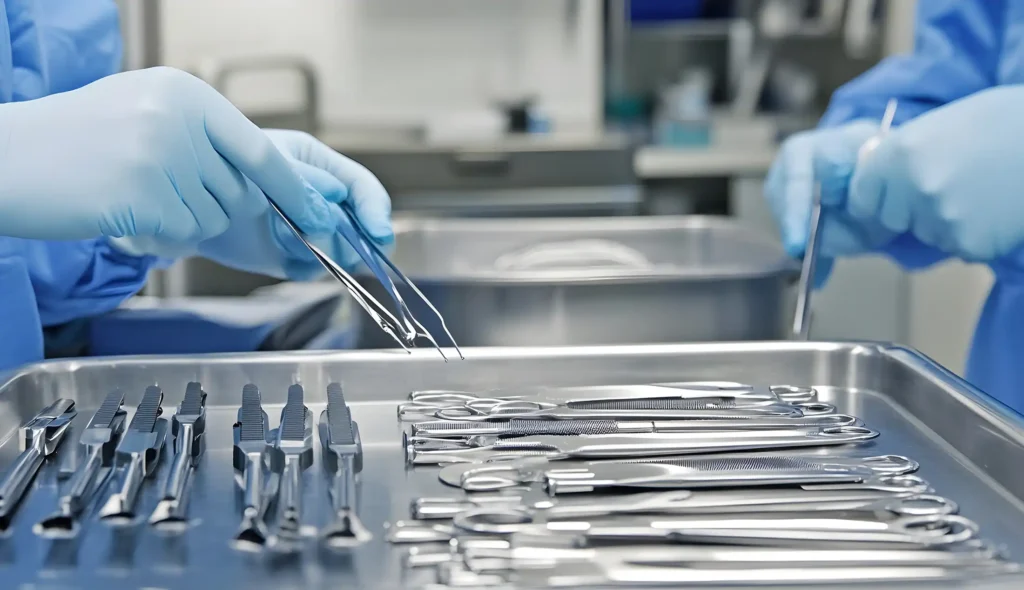
Once instruments are cleaned, inspected, and dried, they move to the clean assembly area, aphysically separate space with positive air pressure and controlled traffic. Here, technicians assemble instrument sets according to count sheets that specify every item, its placement in the tray, and its functional requirements.
Assembly is more demanding than it appears. Technicians must:
- Inspect each instrument for functionality, checking box locks, jaw alignment, ratchet mechanism, and tip integrity
- Identify instruments by name and purpose across dozens of specialty sets
- Recognize when an instrument is damaged, worn, or missing and flag it before the trayreaches the OR
- Arrange instruments in a logical order that supports efficient intraoperative use
A technician who assembles a laparoscopic tray must understand the difference between a 5 mm and a 10 mm trocar, recognize a damaged insufflation port, and know that a missing clip applier needs to be sourced before the tray is wrapped, not discovered by the surgical tech at the backtable mid-case.
This is specialized knowledge. It is learned over months of training and years of experience, and it is the reason why SPD orientation programs in well-run facilities take weeks, not days.
Sterilization: Parameters, Loads, and Documentation
Wrapped and containerized sets move to sterilization, where the technician is responsible for loading the sterilizer correctly, selecting the appropriate cycle, and verifying that sterilization parameters were met before releasing any load.
Steam sterilization (autoclave) is the most common method, but many facilities also use low-temperature sterilization, such as hydrogen peroxide gas plasma or ethylene oxide, for heat- andmoisture-sensitive items like powered equipment, cameras, and certain implants. Each method has specific exposure requirements, biological indicator protocols, and documentation standards.
Every sterilization load is documented: the load number, cycle parameters, chemical indicator results, and biological indicator tracking. This is not bureaucratic overhead — it is the traceability chain that allows a facility to identify and recall instruments if a sterilization failure is detected. Technicians who manage this documentation carefully are maintaining a record that can, inextreme circumstances, determine whether patients need to be notified of a potential exposure.
Implant Processing: A Category of Its Own
Orthopedic and other implant sets represent one of the highest-stakes areas of SPD work, andone of the most time-pressured. Loaner sets from vendors frequently arrive the day before or themorning of a case, sometimes without adequate lead time for full reprocessing.
AORN and AAMI standards require that loaner instrumentation be cleaned and sterilized by thefacility’s SPD department regardless of the vendor’s representation of its sterility. Technicians managing implant sets must verify that manufacturer instructions for use (IFUs) are on hand,that the correct sterilization method is specified, and that biological indicator results are confirmed before the set is released, which, for steam sterilization, typically requires a 24-hour incubation period unless a rapid readout system is in use.
When the OR calls for an implant set that hasn’t cleared biological monitoring, the technician is in the position of enforcing a standard that the surgical team may be pressured to override. That is not a comfortable position, and it is one that reflects the genuine patient safety function SPDserves.
The Throughput Pressure That Never Stops
On a high-volume surgical day, the pace in SPD is relentless. Instruments used in the first cases of the morning need to be reprocessed and available for afternoon cases, sometimes within a two- to three-hour window. Technicians are simultaneously managing decontamination, assembly, sterilization loads, implant tracking, and urgent requests from the OR, often with leanstaffing.
This is where the relationship between the OR and SPD becomes clinically relevant. Instruments returned to decontamination already soaked in enzymatic solution, with the count sheet intactand specialty items clearly identified, move through the reprocessing cycle faster and with fewer errors. Instruments returned dry, incomplete, or without documentation create downstream delays that eventually surface in the OR as missing items or delayed case starts.
The OR and SPD are not separate departments with separate goals. They are two parts of the same instrument lifecycle, and the quality of handoffs between them directly affects patientcare.
What Clinicians Can Do
Understanding SPD workflow has practical implications for perioperative practice. A few things that make a real difference:
Maintain point-of-use treatment throughout the case, keeping instruments moist and wiping gross soil before instruments leave the field. Return instrument sets complete, with count sheets,and flag any damage or missing items clearly rather than leaving SPD to discover them during assembly. Communicate urgent needs early, as a same-day add-on that requires a specialty set needs to reach SPD as far in advance as possible to allow adequate reprocessing time. And when SPD holds a set for biological indicator results, support that decision rather than escalating pressure to release it prematurely.
Sterile processing technicians are not support staffin a peripheral sense — they are frontline patient safety professionals managing a complex, regulated workflow that every surgical case depends on. The more the OR team understands that workflow, the better the partnership functions, and the safer the patient at the center of it.
References
Association of periOperative Registered Nurses. (2024). Guidelines for perioperative practice. AORN, Inc.
Association for the Advancement of Medical Instrumentation. (2017). Comprehensive guide tosteam sterilization and sterility assurance in health care facilities (ANSI/AAMI ST79:2017). AAMI.
Association for the Advancement of Medical Instrumentation. (2023). Flexible and semi-rigidendoscope processing in health care facilities (ANSI/AAMI ST91:2021/(R)2023). AAMI.
The Joint Commission. (2024). Sentinel event data: Root causes by event type. https://www.jointcommission.org/resources/patient-safety-topics/sentinel-event/sentinel-event-data-summary/
Occupational Safety and Health Administration. (n.d.). Bloodborne pathogens standard (29 CFR1910.1030). U.S. Department of Labor. https://www.osha.gov/bloodborne-pathogens
International Association of Healthcare Central Service Materiel Management. (2022). Central service technical manual (9th ed.). IAHCSMM.